



Miami has always been a city that looks ahead. Faced with the unique environmental challenges of living on the water, it’s also becoming one of the country’s most creative laboratories for sustainability. Across South Florida, entrepreneurs, engineers, scientists, artists, and conservationists are reimagining everything from coastal infrastructure and coral restoration to clean transportation and food recovery. The result is a wave of innovation that’s as bold as it is beautiful: 3D-printed seawalls that become thriving marine habitats, underwater art installations that grow living reefs, electric race cars that help shape the future of mobility, and groundbreaking initiatives that protect the natural resources that define our way of life. These nine cutting-edge companies and experiences are turning environmental challenges into opportunities and helping shape a more resilient future for Miami.

Where The Water Flows
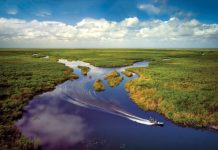
South Florida’s greatest natural wonder is also its greatest life-support system. For more than three decades, The Everglades Foundation has worked to protect and restore the River of Grass through a combination of science, advocacy, and education. Founded in 1993 by outdoor enthusiasts George Barley and Paul Tudor Jones II, the nonprofit has become one of the nation’s leading voices for Everglades restoration, bringing together scientists, policymakers, business leaders, and conservationists around a shared mission.

Its team conducts groundbreaking research on water quality, ecology, and restoration, while policy experts work alongside local, state, and federal leaders to advance critical restoration projects and reduce harmful algae blooms. Through its Everglades Literacy Program, the foundation is also seeding the next generation of environmental stewards by bringing Everglades education into classrooms across Florida.
One of the foundation’s most significant victories has been helping champion the Everglades Agricultural Area Reservoir, a 10,500-acre reservoir paired with a 6,500-acre stormwater treatment area. The project is designed to store, clean, and send up to 120 billion gallons of freshwater south each year, replenishing the Biscayne Aquifer, South Florida’s primary drinking water source, while reducing harmful discharges to coastal estuaries and the Florida Bay. A newly signed agreement between the State of Florida and the U.S. Army Corps of Engineers advances the reservoir’s final components and keeps the project on track for completion in 2029.

Flower Power
Fairchild Tropical Botanic Garden has been inspiring plant lovers since 1938, and its impact now stretches far beyond its 83-acre oasis in Coral Gables. As one of the world’s leading centers for tropical plant research, education, and conservation, the nonprofit is helping protect biodiversity while reimagining what an urban landscape can become.
Its most ambitious effort is the Million Orchid Project, the world’s largest public orchid conservation initiative. South Florida’s native orchids once blanketed local trees before being stripped from the wild more than a century ago. Since 2013, Fairchild scientists have been propagating native orchids in the garden’s laboratories and returning them to public spaces throughout Miami-Dade, from Lincoln Road and the Miami Design District to Coconut Grove and neighborhood parks. More than 700,000 orchids have already been grown toward the goal of a million, while more than 200 schools have joined the effort, giving students the opportunity to cultivate and plant orchids that will bloom in their own communities.
That conservation ethic extends throughout the garden itself. Captured rainwater irrigates much of the landscape, compostable materials are used throughout the café, and sustainable practices—from paperless communications to butterfly conservation initiatives—help ensure Fairchild remains as committed to protecting South Florida’s future as it is to celebrating its natural beauty.

The Coast is Clear
While the World Cup captivated soccer fans across Miami, volunteers gathered at Virginia Key Beach Park with a different goal in mind: protecting our coastline. During a June 17 cleanup led by Ocean Conservancy, participants removed plastic and other debris before it could wash into Biscayne Bay and the Atlantic Ocean.
The effort underscored a simple truth: every piece of litter removed from the shoreline helps protect marine life. Bottle caps, plastic bags, food wrappers, fishing line, and straws are among the most common items found on Florida’s beaches, and they can be deadly when ingested by sea turtles, seabirds, dolphins, and manatees.
The June cleanup was part of Ocean Conservancy’s International Coastal Cleanup, which mobilizes tens of thousands of Floridians each year to remove hundreds of thousands of pounds of trash from beaches and waterways statewide. The organization also helped secure Florida’s statewide ban on the intentional release of balloons, protecting seabirds, sea turtles, and other marine life from a particularly deadly form of plastic pollution.

An Underwater Gallery
While most public art is meant to be admired from the sidewalk, Reefline invites visitors to dive right in. Located just offshore of Miami Beach, the underwater sculpture park and hybrid reef blends monumental public art with coral restoration, resulting in an attraction that’s as captivating for snorkelers and divers as it is beneficial for marine life.
Its inaugural installation, Concrete Coral by internationally acclaimed artist Leandro Erlich, transformed 22 life-size concrete cars into a surreal underwater traffic jam about 780 feet off Miami Beach. More than an artistic statement, the marine-grade sculptures were designed to become living reefs, seeded with thousands of Miami-grown corals that will provide habitat for fish and other marine species while helping restore one of Florida’s most fragile ecosystems.
Conceived by cultural entrepreneur Ximena Caminos, Reefline brings together artists, scientists, engineers, and educators to reimagine the relationship between cities and the sea. During the World Cup, Reefline extended its mission onto the sand with “Big Goals,” a public art installation celebrating the connection between soccer, sustainability, and Miami’s shoreline.

Full Speed Ahead
Motorsport isn’t the first place you’d expect to find environmental innovation. Formula E is determined to change that. Returning to the Miami International Autodrome at Hard Rock Stadium February 20, the all-electric championship will showcase cleaner transportation while delivering edge-of-your-seat competition.
The Miami E-Prix will feature Formula E’s new Gen4 race car. Delivering more than 800 horsepower through an all-electric powertrain, these cutting-edge machines boast active all-wheel drive and advanced regenerative braking that converts braking energy back into electricity. They’re constructed from 100 percent recyclable or reusable materials. Components are selected for ethical sourcing and reduced environmental impact; even the tires incorporate renewable and recycled materials.
The championship itself is certified net zero carbon, and its global race calendar is strategically organized by region to reduce freight transportation and carbon emissions. For the auto industry, Formula E serves as a high-speed laboratory where breakthrough technologies are tested under the most demanding conditions. The innovations racing around the track today could help shape the electric vehicles we drive tomorrow.

A Smarter Seawall
For generations, seawalls have been built to keep water out. Miami-based Kind Designs believes they should also welcome marine life back in. Using large-scale 3D printing and ecological engineering, the company creates Living Seawalls that protect coastlines from flooding and storm surge while providing a habitat for fish, oysters, corals, and other marine species.

Unlike traditional flat concrete walls, these textured structures are designed with crevices and pockets that encourage marine organisms to attach and grow, helping restore biodiversity while improving water quality. Founded by Anya Freeman, the Miami-based company has expanded the concept to include Living Seawall Tiles and Living Shorelines for residential, commercial, hospitality, and government projects.
The technology is already reshaping South Florida’s waterfront. Kind Designs has installed Living Seawalls at the Fontainebleau, Pagani, and The Ritz-Carlton in Miami Beach, while also completing municipal projects in Miami Shores and Longboat Key. The company’s approach has attracted high-profile investors including Mark Cuban and NBA star Kyle Kuzma, helping fuel its rapid expansion as communities rethink how coastlines can be protected.

Turning Scraps Into Soil
The bright pink buckets popping up on doorsteps across South Florida are doing more than collecting food scraps—they’re helping fight climate change. That’s the idea behind Compost for Life, a Miami-based nonprofit founded in 2020 by environmentalist Francisco Torres to make composting easy, accessible, and part of everyday life.
Today, Compost for Life rescues more than 180,000 pounds of food scraps each week across Miami-Dade and Broward counties. Members fill the organization’s signature pink buckets with fruit peels, coffee grounds, eggshells, and other organic waste before setting them outside for a weekly swap with a freshly cleaned bin. Since its launch, the program has diverted more than 10 million pounds of food waste from landfills, transforming it into nutrient-rich compost that supports local farms, schools, and community gardens while helping regenerate South Florida’s soil. Visitors can even tour the Compost for Life farm for a behind-the-scenes look at the process.
Torres has since expanded his mission with Glass for Life, a sister organization founded in 2023 that gives discarded glass a second life through community recycling initiatives. It’s proof that meaningful environmental change doesn’t always require sweeping policy; it can begin with yesterday’s dinner scraps.

From Leftovers To Lifelines
Every rescued meal is one less bag of food headed to the landfill—and one more meal for someone in need. Food Rescue US–South Florida is tackling two major problems at once: keeping perfectly edible food out of the waste stream while delivering nutritious meals to underserved communities.
Since launching locally in 2019, the nonprofit has rescued more than 17 million pounds of edible food using an app that connects volunteers with grocery stores, hotels, restaurants, caterers, and major venues like Hard Rock Stadium. Following the Formula 1 Miami Grand Prix, Food Rescue US volunteers recovered 65,000 pounds of food—equivalent to roughly 55,000 meals—that otherwise would have been thrown out. Instead of ending up in the trash, it is delivered directly to shelters, food pantries, and other hunger-relief organizations throughout South Florida.
The environmental impact is enormous. Food waste accounts for nearly a quarter of landfill material, and as it decomposes, it releases methane, a greenhouse gas approximately 80 times more potent than carbon dioxide over the short-term. With South Florida’s disposal sites nearing capacity, diverting food waste has become an important strategy for reducing emissions and slowing climate change.

Building Better Reefs
A few hundred feet off Miami Beach, the future of coastal protection is taking shape underwater. Led by researchers at the University of Miami Rosenstiel School of Marine, Atmospheric, and Earth Science, the ECoREEF (Engineering Coastal Resilience Through Hybrid Reef Restoration) project combines 3D-printed engineering with coral restoration to create hybrid reefs that provide habitat for marine life while helping protect South Florida’s shoreline from waves, flooding, and erosion.

The project centers on innovative Seahive structures, 3D-printed concrete reefs whose honeycomb-like design slows and disperses incoming wave energy while providing an ideal surface for corals to grow. This summer, researchers deployed three Seahive structures and attached more than 200 adult coral colonies representing seven native species. Thousands of baby grooved brain corals were also introduced, creating the next generation of reef builders. Unlike traditional artificial reefs, these hybrid reefs are designed to grow stronger over time, creating self-building ecosystems.
Developed through nearly a decade of collaboration among University of Miami researchers, engineers, marine scientists, and coral restoration experts, ECoREEF represents a promising new approach to climate resilience. As researchers continue monitoring coral growth, marine life, and wave reduction, the project demonstrates how nature and technology can work together to protect one of the country’s most vulnerable coastlines while restoring the vibrant underwater world that makes South Florida so extraordinary.

Weekend Harvest: Five Farmers Markets Worth The Trip
Want to make a difference? Start at your neighborhood farmers market. Buying directly from local growers not only celebrates Miami’s incredible bounty, it also supports small farms, reduces the distance food travels from field to table, and helps build a healthier, more resilient local food system.
Held inside Aventura Mall, this curated weekend market blends farm-fresh produce with fresh flowers, baked goods, dog treats, gourmet specialties, and handcrafted products from local makers.
Overlooking Biscayne Bay, this beloved Saturday market is one of Miami’s best for locally grown produce, tropical fruit, artisan breads, fresh flowers, honey, and prepared foods.
This sprawling weekend destination features hundreds of vendors selling everything from tropical produce and fresh seafood to handcrafted goods and global street food. Plan to spend a few hours exploring.
Just steps from the beach, this relaxed weekend market offers seasonal produce, baked goods, fresh flowers, artisanal treats, and local vendors in an easygoing neighborhood setting—perfect for pairing with a morning walk along the ocean.
Vizcaya Village Farmers Market
Set amid Vizcaya’s beautifully restored historic village, this charming Sunday market combines local farms, handcrafted foods, flowers, live music, and family-friendly eco activities in one of Miami’s most picturesque settings.







Facebook Comments